Motorcycle maintenance
Motorcycle tyres: pressure and condition in summer around the Garraf
By the workshop · 5 min read · September 3, 2026 · Updated September 21, 2026
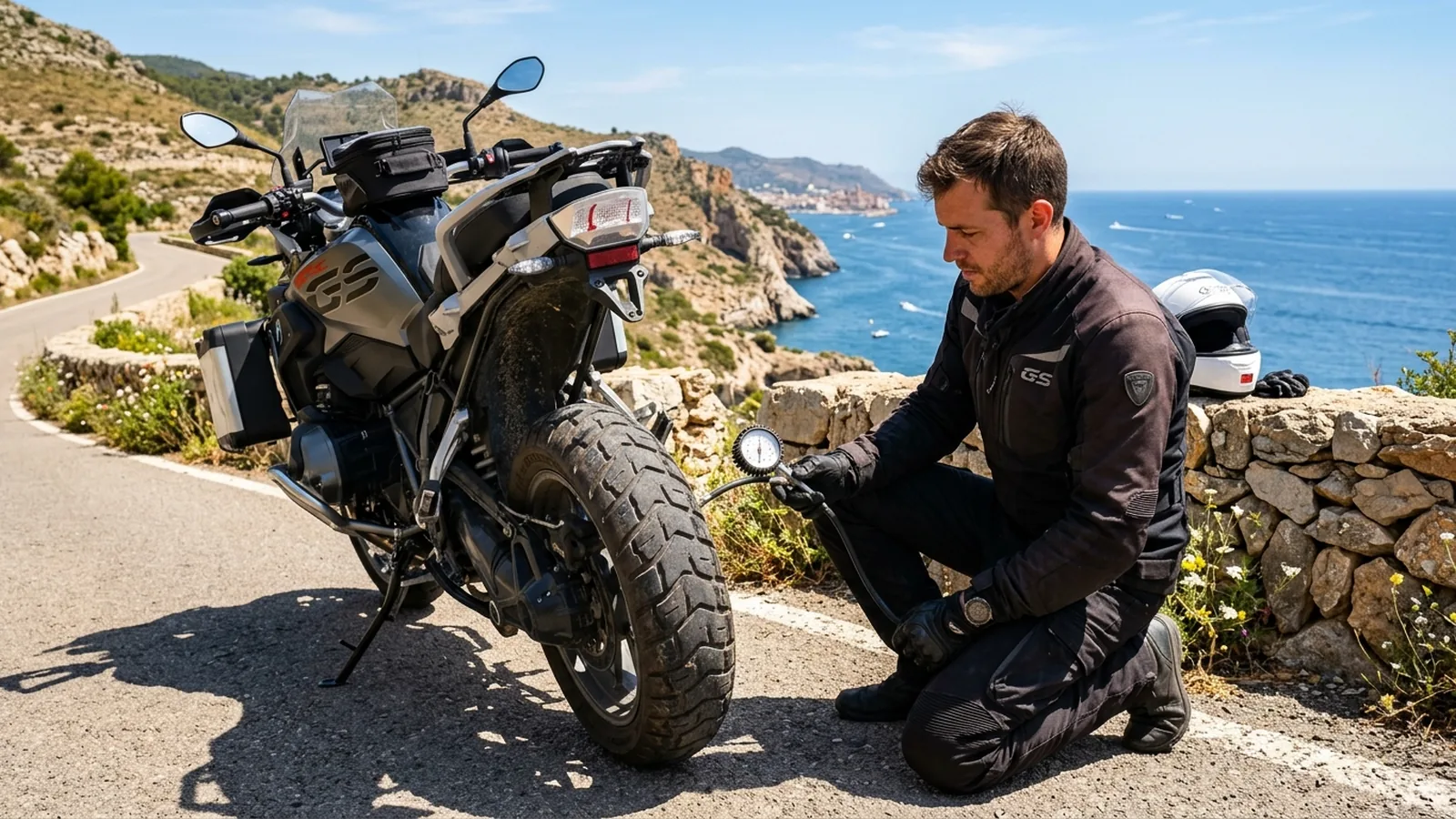
If you ride around the Garraf, the pressure and condition of your tyres make the difference between a relaxed trip and a scare mid-corner. Here is how to check them, which signs mean they must be replaced, and why the heat and the coast road make everything harder.
The problem: tyres suffer more in summer and on the coast
Your tyres are the only contact between your bike and the tarmac. When the pressure is wrong or the tread is worn, the bike brakes worse, corners less precisely and reacts unpredictably. In summer the tarmac in the Garraf can get very hot, which makes the compound (the rubber mix the tyre is made of) heat up faster and wear sooner. Add the coast road, with its linked bends, descents to the harbour and heavy weekend traffic, and you have a demanding setting where a tyre in poor condition is unforgiving.
The solution: measure cold and follow the manufacturer's figure
Pressure is always measured cold, that is, before riding or after only a few kilometres. If you measure it hot, the reading will be higher because the air inside has expanded, and it will not show the real value. Every bike has its recommended pressure on a sticker, usually on the chain guard, the fork or the swingarm (the structure that holds the rear wheel), and also in the owner's manual. There are no universal values: don't make up numbers, always check the ones for your model. Check the pressure at least once a month and before any long ride. If you carry a passenger or luggage, the manufacturer usually gives different values, so check them.
The wear indicator: what it is and how to read it
The wear indicator is a small raised bar at the bottom of the tyre grooves. When the rubber is level with that bar, the tyre has reached the legal limit and must be replaced. On tubeless or radial tyres (those with a more flexible sidewall structure), its position may be marked with the letters TWI on the sidewall. Beyond the indicator, some signs mean a tyre must be replaced even if it has not reached the limit: deep cuts, bulges in the sidewall, cracks from age, or uneven wear that points to a suspension or alignment problem. If in doubt, don't ride: let a workshop check the tyre.
The proof: how to check your tyres before setting off
Before a run along the coast or up to Sitges, give your tyres two minutes. First, check the pressure cold with a gauge you trust, ideally a digital one. Second, look over the tread and find the wear indicator. Third, run your hand over the surface (not if it is hot) to feel for bulges or irregularities. Fourth, look at the sidewalls for cracks or cuts. If everything is fine, ride with peace of mind; if something doesn't look right, come by the workshop before you set off.
Call us or drop by Vila Motor Center
At Vila Motor Center, your multi-brand dealer and motorcycle workshop in Sant Pere de Ribes, we check the pressure and condition of your tyres so you set off safely. If they need replacing, we advise you based on your bike and the way you ride. Drop by the workshop or call us to book a check. And if this article was useful, share it with other riders in the Garraf: the road belongs to everyone.
What you ask us
How often should I check my motorcycle's tyre pressure?
At least once a month and before any long ride. Always cold, and using the figure on your bike's sticker or in the owner's manual.
What is the wear indicator?
It is a raised bar at the bottom of the tyre grooves. When the rubber is level with it, the tyre has reached the legal limit and must be replaced.
Why does summer affect tyres?
Hot tarmac makes the tyre compound heat up more and wear sooner. In the Garraf, with coastal bends and heavy traffic, the rubber works even harder.
Which signs mean a tyre must be replaced even if it hasn't reached the indicator?
Deep cuts, bulges in the sidewall, cracks from ageing or uneven wear. If you see any of these, don't ride and let a workshop check it.
We do it
Would you rather not get your hands dirty?
We get it ready for you at the workshop. Book a slot and pick a real time.