Drivetrain
Motorcycle chain maintenance: how often to lube your chain
By the workshop · 7 min read · September 3, 2026 · Updated September 28, 2026
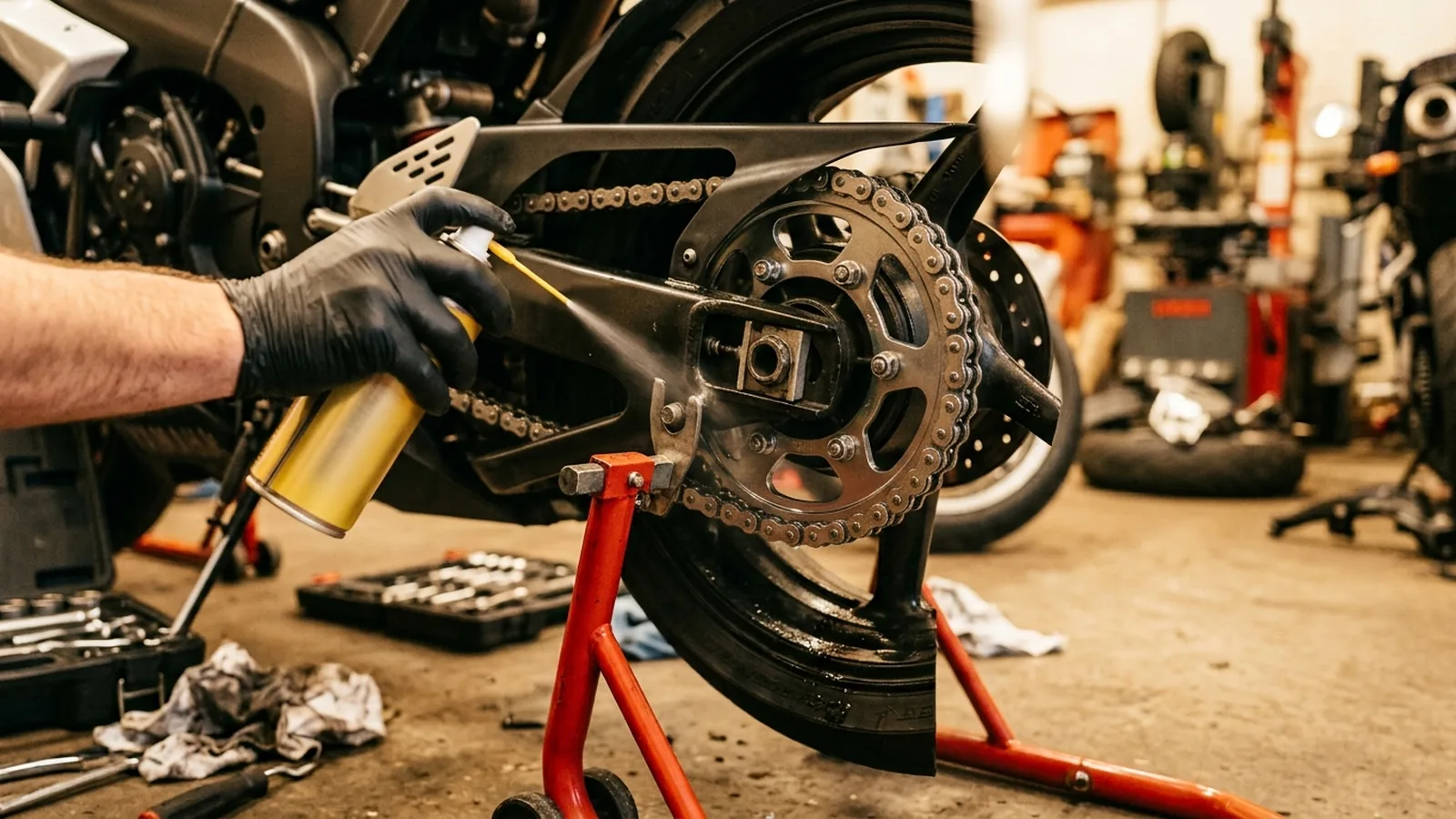
As a guide, a motorcycle chain should be lubricated every 500 to 1,000 km, and always after riding in the rain or washing the bike; check the slack at the same time, and give it a thorough clean every two or three lubes or whenever it looks dirty. The exact interval is in your owner's manual, and the chain's actual condition matters more than the odometer: if it's dry, noisy or showing rust, it's due sooner.
How often should you lube the chain?
The figure you'll see most in manuals and workshops is between 500 and 1,000 km. Your manual has the final say.
What changes the interval is how you ride. Rain, dust, dirt tracks or a lot of heat make the lube last less, so shorten it. And there are two moments when the chain needs lubing no matter what the odometer says: after riding in the rain and after washing the bike.
The sea plays its part here too. Along the Garraf coast, salt air and humidity can make a dry chain rust in a few days, even with the bike parked in the garage. If your bike lives near the beach, check the chain more often than the mileage alone would suggest.
How to clean it without damaging the O-rings
Almost all modern bikes use a sealed chain: small O-rings or X-shaped X-rings that keep grease inside each link. Those seals are what make the chain last, and they're also the easiest thing to damage when cleaning.
Use a dedicated chain cleaner or paraffin (kerosene), with a soft brush and a rag. Turn the wheel with the bike on its stand and the engine off, never with the engine running and a gear engaged.
What not to do: no pressure washer, which forces water past the seals and flushes out the grease inside; no petrol, harsh solvents or kitchen degreasers, which dry out or swell the rubber; and no wire brushes.
Afterwards, dry the chain with a clean rag and let the cleaner evaporate before lubing.
How to lube it properly
The best time is after a short ride, when the chain is warm: the lube penetrates better. With the bike on its stand and the engine off, apply the lube to the inner side of the chain, the side that touches the sprockets, aiming at the rollers and at the sides where the seals are. Turn the wheel by hand until the whole chain has gone round once.
Use a chain lube that's safe for O-rings. General-purpose oils and products with strong solvents won't do.
Wipe off the excess with a rag: surplus lube doesn't lubricate, it just collects grit and flings onto the wheel. And let it set before riding, ideally for a few hours or overnight, so it doesn't fly off.
Watch the rear tyre and brake disc: if any lube gets on them, clean them before you ride; the disc with brake cleaner.
Chain slack: how to measure it
A chain that's too loose can jump off the rear sprocket and causes snatching as you open and close the throttle. One that's too tight punishes the front sprocket, the wheel bearings and the gearbox output shaft, and can even snap when the suspension compresses.
Slack is measured at the midpoint of the lower run, between the two sprockets: move the chain up and down by hand and measure the total movement with a ruler. On most bikes it's between 20 and 40 mm, but the exact figure, and whether to measure with the bike on its stand or on its wheels, is in the manual or on a sticker on the swingarm.
One important detail: a chain doesn't stretch evenly along its length. Turn the wheel and measure at several points; set the slack at the tightest point. When adjusting, move both adjusters by the same amount so the wheel stays aligned, then tighten the axle to the torque the manufacturer specifies.
Signs the chain and sprocket kit is worn
Lubing and adjusting greatly extend a chain's life, but they don't make it last forever.
The rear sprocket teeth, instead of being symmetrical, are pointed or bent over into a hook shape. The front sprocket, which is smaller and works harder, is usually even worse.
There are stiff links that don't move freely and stay kinked when the chain hangs.
If you pull the chain rearwards at the back of the rear sprocket, it lifts away and exposes a good part of the tooth.
You have to adjust it constantly, or the adjusters have run out of travel. Also, metallic noise or snatching even when the slack is correct.
With just one of these signs, it's worth having a mechanic look at it. With two or more, the kit almost certainly needs replacing.
Chain and sprockets are replaced together
The chain and sprocket kit is three parts that wear together: the chain, the front sprocket (the small one, on the engine output) and the rear sprocket (the large one, on the back wheel). As the chain stretches, the teeth gradually adapt to that worn pitch.
That's why it makes no sense to replace just one part. A new chain on worn sprockets wears out quickly and is noisy, and new sprockets with an old chain wear out straight away. The whole kit is replaced, with the pitch and tooth counts the manufacturer specifies.
How long does a kit last? As a very broad guide, anywhere from about 15,000 to over 40,000 km, depending on power, chain type, use and, above all, maintenance. A well-lubed, correctly adjusted chain lasts far longer than a neglected one.
After rain or washing the bike
Water is a chain's worst enemy. It washes the lube off the surface and, if it stays between the rollers, rust starts within hours.
When you wash the bike, use water and bike shampoo at low pressure, without pointing the hose at the chain. Dry it with a rag or a short ride, then lube it once it's dry and warm. If you've ridden in the rain, same again: dry it, clean it if it's picked up mud, and lube it that same day.
A link that has rusted stiffens and doesn't recover. If you're leaving the bike parked for a few weeks, lube the chain before you put it away.
How we do it in the workshop
At Vila Motor Center we check the whole drivetrain: slack at several points along the chain, stiff links, the teeth on both sprockets, the position of the adjusters and wheel alignment. If the chain only needs cleaning, lubing and adjusting, we'll say so; if it needs a new kit, we'll explain why and what it will cost before we touch anything.
As a multi-brand workshop we work on road bikes, adventure bikes, naked bikes and sports bikes from many different makes, and we fit the kit with the sizes your bike's manufacturer specifies.
We're on the Rambla del Garraf in Sant Pere de Ribes, about 8 minutes from Vilanova i la Geltrú and 12 from Sitges. Use our free online booking, pick a day and time that suits you, and tell us on the form if you hear noise or feel any snatching.
What you ask us
How often should you lube a motorcycle chain?
As a guide, every 500 to 1,000 km, and always after riding in the rain or washing the bike. The exact interval is in your manual; with dust, heat or sea air, it's worth shortening it.
How often should I lube the chain if it rains or I wash the bike?
Every time. Water washes off the lube and the chain starts to rust within hours. Dry it, clean it if it's picked up mud, and lube it the same day, with the chain dry and warm.
How often should a motorcycle chain be cleaned?
A thorough clean every two or three lubes is usually enough, or sooner if it looks black or gritty. Use chain cleaner or paraffin and a soft brush; never a pressure washer or petrol, which damage the O-rings.
How much slack should a motorcycle chain have?
On most bikes, between 20 and 40 mm measured at the midpoint of the lower run, at the tightest point after turning the wheel. The exact figure and how to measure it are in the manual or on a sticker on the swingarm.
When should the chain and sprocket kit be replaced?
When the rear sprocket teeth are pointed or hooked, there are stiff links, the chain lifts away from the back of the rear sprocket, or the adjusters run out of travel. Chain and sprockets are always replaced together.
We do it
Would you rather not get your hands dirty?
We get it ready for you at the workshop. Book a slot and pick a real time.