Brakes
When to replace motorcycle brake pads: how often and how to tell
By the workshop · 7 min read · September 3, 2026 · Updated September 28, 2026
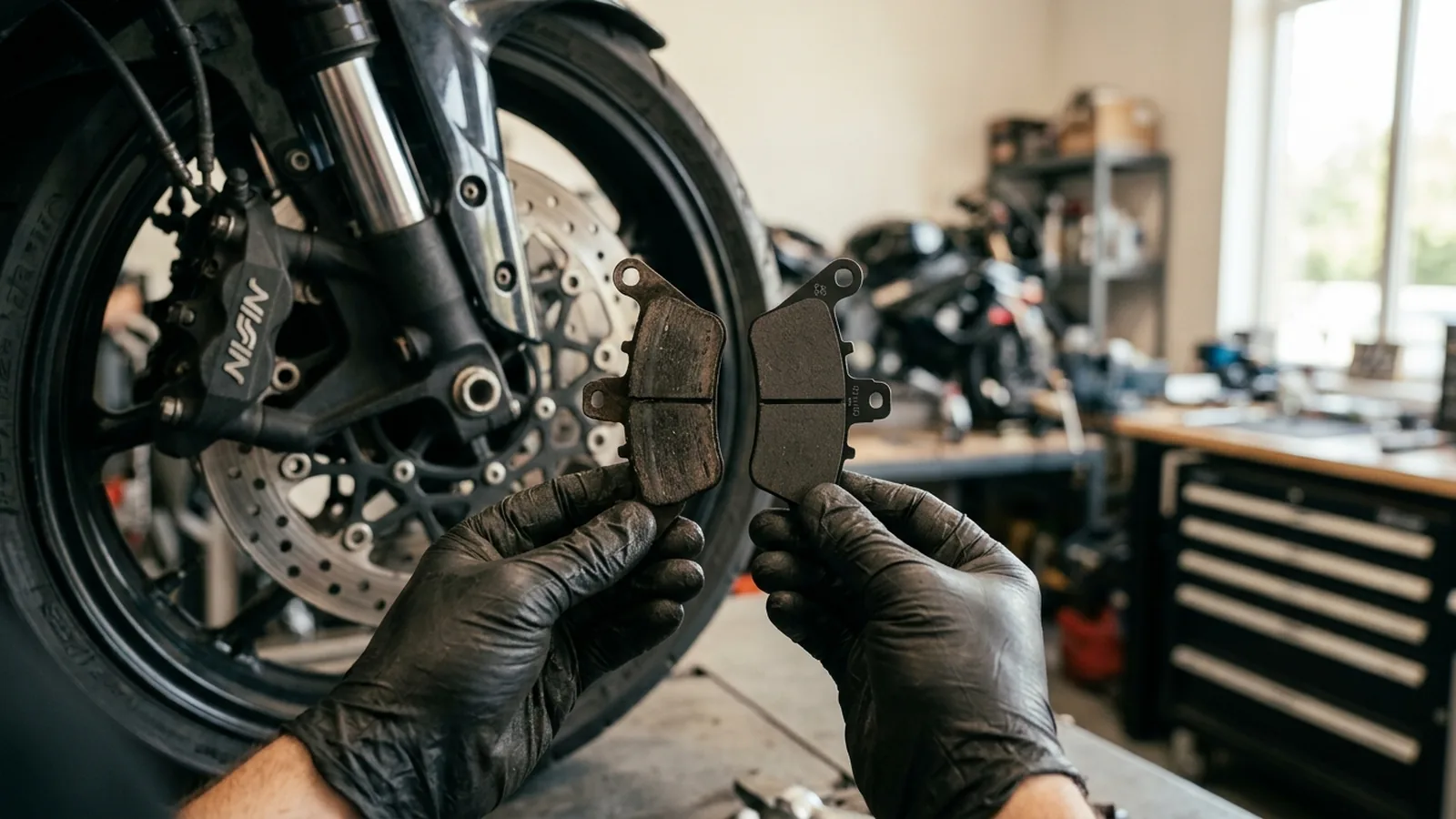
Motorcycle brake pads should be replaced when they have 1.5 to 2 mm of friction material left, or when they reach the manufacturer's wear groove or indicator, not at a fixed mileage. As a very broad guide, a set of front pads can last anything from under 10,000 km in town to over 25,000 km of relaxed road riding; but your owner's manual has the final say, and so does what you see when you check them every few weeks.
How often do brake pads need changing?
There is no mileage figure that works for every bike. How long pads last depends on the model, the weight of the bike with rider, passenger and luggage, the pad compound and, above all, how and where you brake.
As a rough and very broad guide, a set of front pads can last less than 10,000 km in town or with sporty riding, and more than 25,000 km on open roads at a gentle pace. A scooter doing short trips around Vilanova, with traffic lights and roundabouts, wears them out much sooner than an adventure bike doing motorway miles.
So the useful thing isn't counting kilometres, it's looking at them. Take a quick look every few weeks and, at the very least, at every oil change. It's time to replace them when they have 1.5 to 2 mm of material left or when they reach the wear indicator. If your manual gives a different figure, follow the manual.
How to check pad thickness without taking anything apart
On most bikes you can see the pads without removing anything. With the bike on its stand or safely upright, look at the caliper from below or from behind, using a torch if needed. You'll see the edge of both pads: the metal backing plate that holds them and, bonded to it, the layer of friction material that touches the disc.
What matters is that layer, not the backing plate. Many pads have a groove in the middle of the material: if you can no longer see the groove, they're at the limit. Others have a notch on the side or a metal tab that rubs on the disc when they're worn out.
Check both pads in each caliper, because sometimes one wears faster than the other, especially if the pistons are dirty or a slider pin isn't moving freely. If there are twin discs at the front, check both calipers.
Noises and warning signs
Brake pads don't light up a warning on the dash, so they warn you in other ways. The clearest is a constant metallic squeal when braking: usually the wear indicator, or the backing plate itself, rubbing on the disc. From then on, every stop scores the disc.
Other signs: the bike takes longer to stop with the same pressure on the lever, you feel vibration or a pulse through the lever or pedal, there's a burning smell after a long descent, or the wheel gets covered in black dust very quickly.
A spongy feel, on the other hand, isn't usually the pads: it points to the brake fluid or air in the system. In any of these cases, don't wait for the next service: brake gently and get it looked at.
Front and rear pads don't wear the same
Under hard braking, the weight shifts onto the front wheel, which does most of the work. That's why on most bikes the front pads wear out before the rear ones, sometimes a lot sooner.
There are exceptions. Many scooter and cruiser riders use the rear brake a lot, and then it's common for the rear set to wear faster.
Whichever axle it is, the rule is the same: always replace the complete set on that axle. If the bike has twin front discs, the pads in both calipers are changed at the same time, even if one looks slightly better, so that both brake equally. On long descents such as the Costes de Garraf, an unbalanced brake shows in the feel and in how it heats up.
Organic, sintered or semi-metallic pads
Not all pads are the same, and the type also affects how long they last. Organic pads are gentle on the disc, quiet and bite well from cold, but they wear faster and handle heat less well.
Sintered pads, made from metal particles pressed together at high temperature, last longer, cope better with heat and work better in the wet, at the cost of being slightly harder on the disc.
Semi-metallic pads sit in between: tougher than organic and gentler than sintered.
The key is not to switch type blindly. The disc has to be compatible with the compound you fit, and some discs, especially on older or lighter models, aren't designed for sintered pads. The safe choice is the type the manufacturer specifies or an approved equivalent for your bike.
The disc and the brake fluid
Changing pads without looking at the disc is only half a check. Discs wear too, and they have their minimum thickness stamped on them, usually as «MIN TH» followed by a figure in millimetres. If the disc is below that, has deep grooves or a pronounced lip at the edge, or is warped and makes the lever pulse, it needs replacing: new pads on a disc like that brake worse and wear faster.
Brake fluid is the other thing people forget. Most bikes use DOT 4; check the reservoir cap or the manual to be sure. The fluid absorbs moisture over time, which lowers its boiling point: on a long descent it can vaporise and leave the lever with no feel. That's why it's changed by time rather than mileage, generally about every two years or whenever the manual says.
Bedding in new pads
Freshly fitted pads don't brake at full strength from the first metre. They need to bed in against the disc and leave a thin layer of their material on it, so that contact is full and even.
Before you even set off, pump the lever and pedal several times until they firm up: fitting new pads pushes the pistons back in, and the first application might not respond.
Then, for the first hundred to two hundred kilometres, or whatever the pad manufacturer recommends, brake progressively: several gentle and moderate stops from moderate speed, letting the brakes cool in between.
And be careful with the disc: a drop of grease, chain spray or the wrong cleaner on it or on the new pads can ruin them.
How we do it in the workshop
At Vila Motor Center, on the Rambla del Garraf in Sant Pere de Ribes, we check the whole brake: pad thickness in every caliper, the condition and thickness of the disc against its minimum, the calipers and slider pins, and the colour and level of the fluid. Then we tell you what actually needs doing and what it will cost before we touch anything.
We're a multi-brand workshop: we work on scooters, road bikes, adventure bikes and cruisers from many different makes, and we fit the compound that's right for your bike.
We're about 8 minutes from Vilanova i la Geltrú and about 12 from Sitges. Use our free online booking to choose a day and time that suits you, and tell us on the form if you hear any noise or notice anything odd when braking.
What you ask us
How often should motorcycle brake pads be changed?
When they have 1.5 to 2 mm of material left or reach the wear indicator, not at a fixed mileage. As a broad guide, a set of front pads can last from under 10,000 km in town to over 25,000 km of relaxed road riding. Your owner's manual, and what you see when you check them, have the final say.
How often should I check my motorcycle brake pads?
A quick look every few weeks and, at the very least, at every oil change or before a trip. On most bikes you can see the thickness by looking into the caliper with a torch, without taking anything apart.
Should front and rear brake pads be replaced at the same time?
Not necessarily: each axle is done according to its own wear, and the front pads usually wear out first. What is always replaced together is the complete set on one axle; with twin front discs, the pads in both calipers at once.
How often should motorcycle brake fluid be changed?
By time rather than mileage: generally about every two years, or whatever the manual says. Most bikes use DOT 4, but check the reservoir cap before topping up or changing it.
What happens if I wear the pads down to the metal?
The metal backing plate rubs on the disc and scores it within a few stops, the bike brakes much worse, and you'll most likely need a new disc as well. A set of pads on time costs far less than pads and a disc.
We do it
Would you rather not get your hands dirty?
We get it ready for you at the workshop. Book a slot and pick a real time.